

VectorMine // Shutterstock
What is just-in-time learning?
A customer calls in to ask for a refund. What’s the policy for that, again? You can escalate and hope your supervisor picks up quickly, ping a coworker for a tip, or wing it and hope for the best. And when this question comes up again in the future, you’re back to zero.
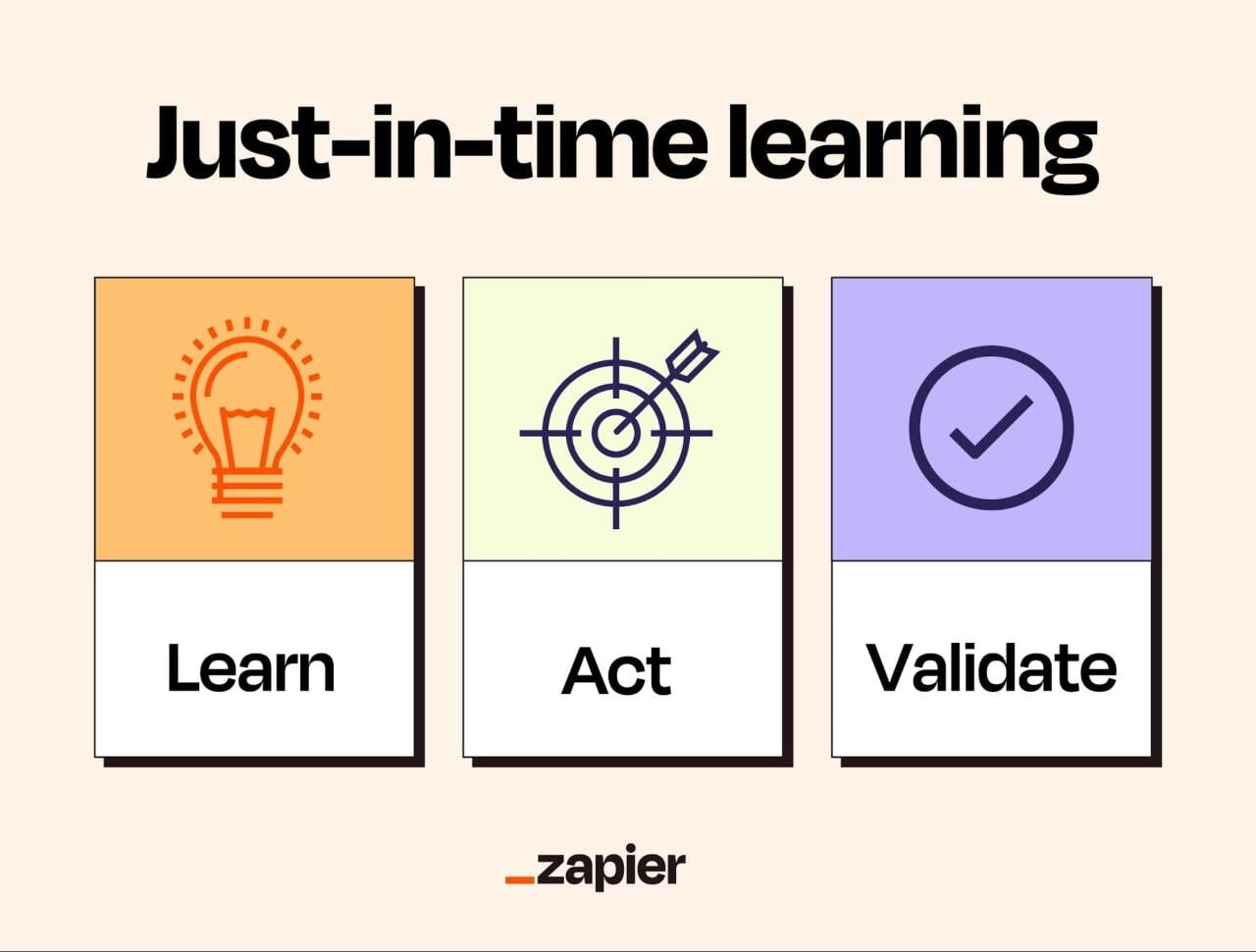
This is where just-in-time learning comes in: Find information in the moment, act on it fast, validate results, and save it for later.
By the end of this guide from Zapier, you’ll know how to get more done without drowning in deep dives.
What is just-in-time learning?
Zapier
Just-in-time (JIT) learning is a method where you learn the smallest useful thing, right when you need it, in the context where you’ll use it. Instead of taking a long course “just in case,” you find the answers and apply them immediately (“just in time”).
In practice, a developer asks, “How do I write an SQL join?” two minutes before writing the query. A manager looks up “how to run a stay interview” 15 minutes before meeting with an employee who might leave. A sales rep searches “compliance requirements for financial services clients” just before pitching to this kind of client for the first time.
This do-as-you-learn process will push you into Google searches, internal wikis, and plenty of other resources. As you find solutions, you can save and turn them into standard operating procedures (SOPs), templates, and decision trees, making it easier to repeat the correct process in the future.
AI tools can make JIT learning much faster because AI generates responses that are matched to what you’re trying to solve. Of course, it also introduces a bit of risk: The responses can be too long, overwhelming, or not match constraints.
When just-in-time learning works best (and when it doesn’t)
JIT learning is a strong tactical approach, but it won’t work for every task.
- JIT learning is best for tasks where you can easily tell if the result is wrong or inappropriate. If you vibe code to fix a small HTML issue on your page, reloading your browser will tell you if that worked or not. Any mistakes you make should be low-risk and easy to reverse, too—Ctrl + Z, versioning tools, and working on a copy of a document are your friends. Tasks that have clear steps are also fair game: anything from a step-by-step guide on how to start a project in a tool you rarely use to how to log company expenses correctly.
- JIT learning is risky if you can’t verify the result quickly. Consider the cost of failure: if personal data is at stake, someone could take legal action, or implementing the change would break trust (either with your customers or your manager). Don’t wing it.
Sometimes a task is mixed. It delivers immediate feedback (good match) but has serious consequences if mishandled (bad idea). Don’t give up on JIT learning just yet: In this case, you can stage your approach by building with dummy data. If it’s working well, you can feed it real data and see how the results compare. If everything is still smooth at this point, use your prototype in a real task and measure the results.
The JIT learning loop
Step 1: Define what ‘done’ means
Having no objective is a recipe for staying in an endless loop. Define what done means, and keep it as small as possible: Adding too many constraints and controlling for too many things will extend the time to complete and overwhelm you.
If your definition of done is “learn PowerPoint,” that’s already too big. “Make a clean five-slide deck with title, agenda, and summary” is just right.
Step 2: Get targeted help
Search for the smallest answer that gets you to “done.” Skip comprehensive guides and courses, and don’t read 10 resources back-to-back. Set a time limit or a maximum number of sites you’ll visit.
Step 3: Apply immediately
This is the moment: Use the help resources you found to act right away. If you’re using live data, work on a copy for safety. Do as much as you can without researching more. If you hit a snag, go back and troubleshoot it with the same mindset. Look for actionable, small steps.
Step 4: Validate
Check your work against the requirements. Test calculations, compare to any source data, and use your critical thinking skills to evaluate if the solution is on target. If you’re close to the end, don’t let perfectionism extend the time to finish: Aim for minimum viable.
Step 5: Document what worked
If your solution works, save your resources, steps, checklists, or decision trees for future reference. Use the feedback you got from managers, coworkers, or customers to make adjustments, and then store the document somewhere your team can access it.
Just-in-time learning example
Your manager sends a Slack message asking for an Excel chart for the next team meeting: “Hey, I need a report on monthly costs versus budget. Could you jump on that quick for the meeting? Flag all the months we went over budget by 10%. Thanks.”
The meeting starts in 20 minutes. Your turn.
Step 1: You turn off all distractions and set a timer for 10 minutes. You define “done” as having an Excel chart and a table of monthly costs compared with the target budget.
Step 2: Open an AI chatbot and ask for the “fastest way to create budget vs actual costs in Excel and highlight months over budget by 10%. Keep the answer short and actionable.”
Step 3: The AI gives you the exact steps. Start by creating a new sheet inside Excel, and copy the live data as needed. Structure the columns, create a pivot table, add a calculate field for the 10% threshold, apply conditional formatting, and to top it off, generate the chart on the table. (You can use Microsoft Copilot to help in this case.)
Step 4: You check if the guidance was on point by checking the results for three months manually. Calculate the variance by hand, confirm the conditional formatting works as it should, and read the results to spot anything weird. You should be out of time by now, so it’s time to save and join the meeting.
Step 5: After the meeting, document every step, adjust based on feedback, and save it as “Budget variance chart – monthly tracking.” The next time your manager drops a line on Slack and wants the same thing, you’ll be ready.
Scaling just-in-time learning to your team
After weeks of just-in-time learning and saving procedures, you’ll have solved dozens of problems and built a solid cache of documented solutions. The next step is to make that knowledge work for everyone.
- Build your microlearning inventory. List workflows that always raise questions, are too complex, and where people usually get stuck. Pick one per week and document as you work through it.
- Document while you solve. Capture your process for tricky workflows: all the steps, decision points, resources, mistakes you made, and how you fixed them. Write as if you won’t touch this task again, so you can still solve the issue when you forget and others can execute even if reading for the first time.
- Make it easy to find. Choose one place to store your documentation—this can be a note-taking platform, an LMS, or an internal tool—and stick to it. As you build your “solution catalog,” decide on a structure/formatting standard to reduce cognitive friction, and use descriptive titles.
- Keep them fresh. Work evolves, so it’s natural that a checklist that worked today won’t help in six months. Assign who owns each document: Some platforms allow you to do this, but if you’re unlucky, a single sentence with your name and email at the end will work. Revisit each document on a set cadence depending on how many changes you expect over time. You can refresh it monthly or quarterly, for example.
- Embed it in the flow of work. When you hit an obstacle, you usually have to tab out to search for a solution. What if you didn’t have to and could get instructions as you work? This is especially useful if you’re using internal tools that allow embedding, as you can include help content right inside your CRM, or on a side tab on your customer support agent interface. Start from the documentation, go through the flow, brainstorm tooltips or contextual help, and include a link to the original for easy access.
- Combine microlearning resources into SOPs. For complex workflows, a single document might not be enough. Pack multiple resources into a single SOP that people can follow from top to bottom.
- Automate processes. As you create more documentation, notes, and SOPs, you’ll realize that some steps are just busywork: copying/pasting values from one platform to another, sending an email to someone, or searching for data in a specific platform. Start automating these workflows to save even more time.
You know you’re winning if people are asking fewer repetitive questions, when productivity metrics improve, and when your teammates can complete tasks independently without escalating them.
The pitfalls of just-in-time learning
JIT is a practical method for solving problems: Learn what you need when you need it, execute fast, save for later. It sounds easy, but how you consume information and what you believe about your own abilities can get in the way.
The first friction point is information overload, especially if you value being thorough. Nothing kills momentum faster than reading a ChatGPT response with 15 sections and five bullet points each. Our working memory isn’t designed for this kind of digital firehose. This usually manifests as freezing, drops in motivation, brain fog, and difficulty moving forward. Be ruthless: Cut the bloat and focus on the next smallest task.
The second one is having a fixed mindset: believing that traits can’t evolve or change. This shows up when a solution guides you through something you decided you’re not good at—such as writing JavaScript—and you choose not to do it because “you’re not a coder.” Do it anyway, and see how it turns out: The more you surprise yourself, the more you’ll build confidence. That will help you tackle thornier challenges in the future.
But there’s a trap once you get comfortable: It’s possible to mistake good execution for mastery of a topic. An easy way to diagnose this is to put the checklists away: Can you still finish the task with the same level of quality? Real mastery is building foundational knowledge—the why behind the task, the reasoning that separates what’s a good outcome from a bad one. That usually requires experimentation, taking a course, or talking to experts in the field.
The second path is choosing the best kind of media to convey an idea. For most circumstances, text is fine. For others, images may be a better fit. For example, to describe before/after or bad result/good result. Videos are good for software guides and assembling tutorials—or, if a video would be too much, a well-placed GIF can be super effective as well. Think about the objective of the task and what would be the most intuitive way to help someone achieve it.
Start learning just in time
Don’t lose momentum: You’ve got JIT learning fresh in your brain, why not ace a task that’s been hounding you lately?
- Pick a task you’ve been struggling with, that’s unclear or confusing, or that’s raising a lot of questions with your team.
- Run the JIT loop.
- Organize your notes and save them for future reference.
The next time you come across that task, the dread you usually feel will be replaced by confidence.
This story was produced by Zapier and reviewed and distributed by Stacker.

